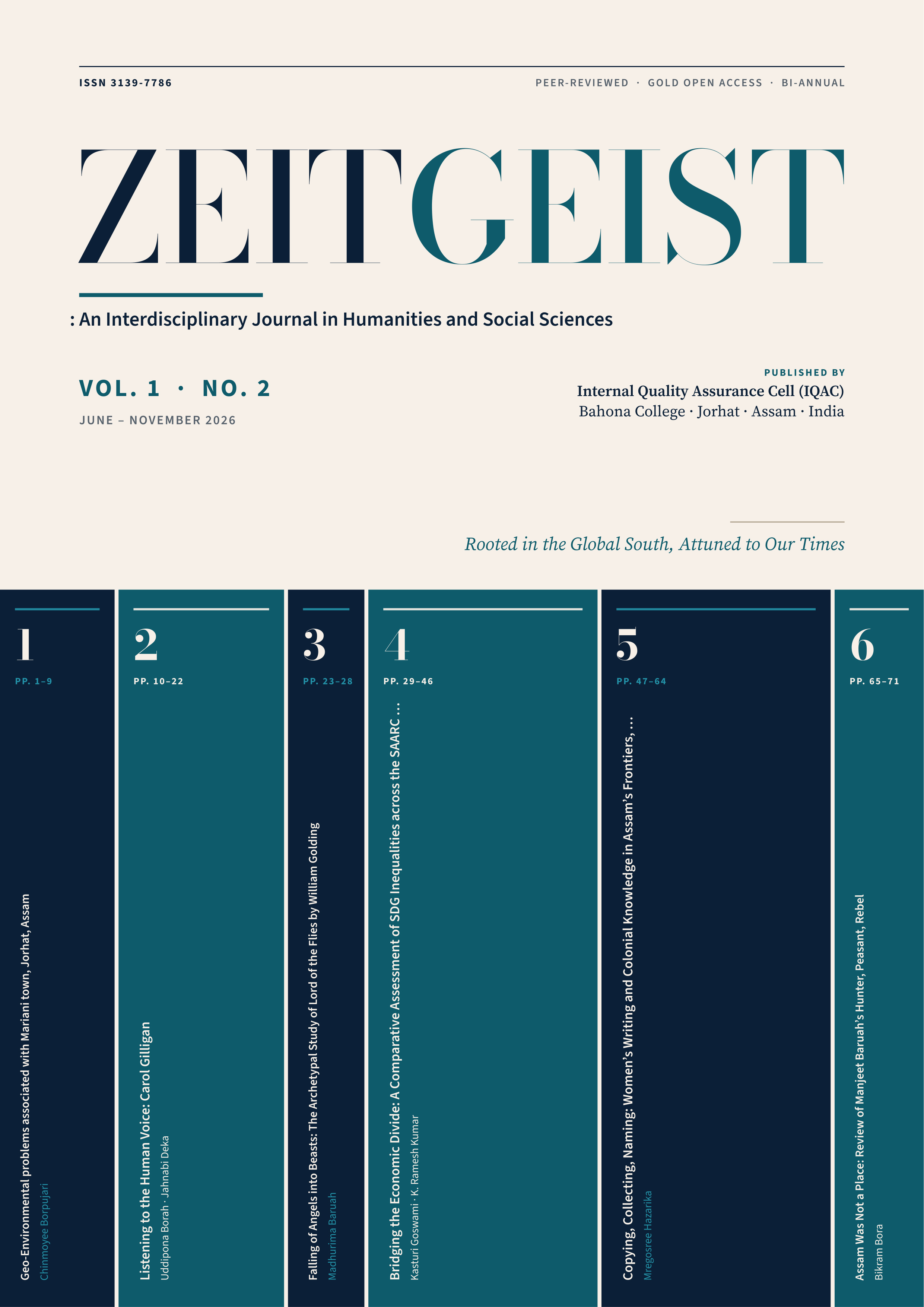
Copying, Collecting, Naming
Women’s Writing and Colonial Knowledge in Assam’s Frontiers, 1916–1953
Keywords:
Travel Writing, Women’s Writings, Assam, Northeast India, Colonial Knowledge, Archives, Kingdon-WardAbstract
This paper examines accounts by three European-origin women who wrote about Assam and its frontier regions between 1916 and 1953. They are: Jessie T. Moore’s Stray Leaves from Assam (1916), Jean Kingdon-Ward’s My Hill So Strong (1952), and Ursula Graham Bower’s Naga Path (1950) and The Hidden Land (1953). It places these works alongside selected writings by other western men operating in these regions in order to examine how colonial knowledge was assembled, transmitted and recorded. Rather than treating gender as a self-evident determinant of textual perspective, the paper distinguishes two recurrent registers. First, a transmitted documentary register, consisting of reports, statements, returns, correspondence and other materials reproduced from institutional sources. And second, a situated relational register, through which writers recorded the labour, translation, payment, negotiation and interpersonal relationships that made movement and knowledge production possible. The distinction is most visible in the paratexts and documentary insertions. Moore’s mission volume incorporates conference statements, statistical returns and resolutions while also recording the staff, linguistic work and domestic circumstances of a station. Kingdon-Ward’s account of the 1950 earthquake preserves an expeditionary staff structure, payment arrangements and the labour behind botanical collection alongside official reports. Bower’s The Hidden Land places an account of administrative methods and personnel beside an extended narrative of interpreters, traders, slaves and local intermediaries. Comparison with male-authored commercial and scientific society publications, including two authors who wrote in both venues, suggests that genre, institutional audience and publishing venue strongly shaped the visibility of local intermediaries and of documentary authority. The paper argues that these women’s writings are valuable not because they offer an alternative or inherently “less colonial” perspective, but because their particular institutional and practical positions preserved evidence of the relational and material labour through which colonial knowledge was produced. Read as composite textual archives rather than homogeneous narratives, these books disclose people and transactions that official records frequently rendered peripheral.
Additional Files
Published
How to Cite
Issue
Section
License
Copyright (c) 2026 Zeitgeist: An Interdisciplinary Journal in Humanities and Social Sciences

This work is licensed under a Creative Commons Attribution-NonCommercial-NoDerivatives 4.0 International License.